Our Pick: Vicks
Check price on Amazon →Diffuser vs Humidifier: They Are Not the Same Machine
A diffuser exists to put scent into a room and a humidifier exists to put water into it, and the gap between them is not a matter of degree. A 500 mL diffuser and a 6 L humidifier are two different appliances doing two different jobs, and buying the first to fix dry air is the most common mistake in this whole category. Here is the output difference in plain numbers, where essential oils actually belong, the handful of units that legitimately do both, and which one to buy for scent, for dryness, and for a nursery.
By The Vapor Reviews DeskUpdated 2026-09-05~9 min read Ranked on verified output, never box claimsHow we research
They look alike, they both plug in, they both produce a visible plume, and they are not interchangeable. A diffuser is a fragrance appliance: its job is to disperse a few drops of essential oil, and the water in it is a carrier rather than the point. A humidifier is a moisture appliance: its job is to raise a room's relative humidity, and it is sized to move enough water to actually do that. The mechanism inside many of them is identical, an ultrasonic disc atomizing a reservoir, but the scale is not, and scale is the entire difference.
Look at the tanks and the argument is over. Diffusers in the mainstream are 300 to 700 mL: the ASAKUKI 500 mL class, the design pieces, the plug-ins. Bedroom humidifiers start around 2.5 L and the popular sizes are 4 to 6 L, with large-room units at 10 and 11 L. A 6 L humidifier holds twelve times what a 500 mL diffuser holds, and it is built to empty that tank into the air of a room over a night. A diffuser running the same night puts a rounding error of moisture into the same space. That is why people who buy a diffuser for a dry bedroom come back disappointed.
The other half of the confusion runs the opposite way: people who own a humidifier and want their room to smell of eucalyptus, so they tip oil into the tank. That is the one thing you must not do, unless the manufacturer has provided a dedicated oil tray, because oils are not water-soluble and a plain humidifier tank is not designed to have them in it. Everything below sorts out which appliance you need and where the oil is allowed to go.
The short version
- A diffuser is for scent, a humidifier is for moisture. The difference is output volume, and it is roughly an order of magnitude.
- Typical diffuser tanks are 300 to 700 mL. Typical bedroom humidifier tanks are 2.5 to 6 L, with large-room units at 10 to 11 L.
- A diffuser will not meaningfully move a room's relative humidity. If your bedroom reads below 30 percent, a diffuser is not the fix.
- Never add essential oil to a plain humidifier tank. Oils are not water-soluble; they coat ultrasonic transducers, degrade wick filters, and can attack plastics and seals.
- Oils belong in an actual diffuser, or in a humidifier with a dedicated essential-oil tray such as the Levoit 3 L at $43.99 or the Frida Baby 3-in-1 at $43.49.
- Waterless diffusers (Vitruvi Air, Aera, Pura) add no moisture at all, which makes the distinction absolute rather than a matter of degree.
- Buying both is often the right answer, and it is cheap: an ASAKUKI 500 mL is $19.99 next to whatever humidifier the room actually needs.
Our top-rated vaporizers
Whatever you decide, these are the picks we recommend across every category, ranked on verified output and value. Live price check on each.


As an Amazon Associate we earn from qualifying purchases, at no cost to you.
What you'll need
The six things that make a steam vaporizer or humidifier actually work for you: the medicated liquid and pads that turn steam into relief, the treatment and cleaning tools that keep the tank safe, and a meter so you know when the room is right. Prices are approximate at time of writing.




The output gap, in numbers
The clearest way to see the difference is to put the tanks next to each other. Every figure below is the maker's stated capacity, and each links to the live listing.
| Appliance | Type | Tank | Live price (September 5, 2026) |
|---|---|---|---|
| ASAKUKI 300 mL quiet | Diffuser | 300 mL | $18.99 |
| ASAKUKI 500 mL | Diffuser | 500 mL | $19.99 |
| ASAKUKI 700 mL | Diffuser | 700 mL | $24.99 |
| Vitruvi Stone | Diffuser (ceramic ultrasonic) | Small reservoir | $129.99 |
| Vitruvi Air | Waterless diffuser | No water at all | $149.99 |
| Levoit 2.5 L top fill | Humidifier | 2.5 L | $29.79 |
| Levoit 3 L with oil tray | Humidifier with oil tray | 3 L | $43.99 |
| Levoit LV600S | Humidifier | 6 L | $109.00 |
| Levoit OasisMist 1000S | Humidifier | 10 L | $149.99 |
A 500 mL diffuser holds one sixth of what an entry-level 3 L humidifier holds and one twelfth of a 6 L unit, and it is designed to release that small volume slowly over hours so the scent lasts, not quickly so the room gets damp. The gap is not marketing; it is the design brief. Prices verified live via the Amazon Creators API on September 5, 2026.
What each machine is actually for
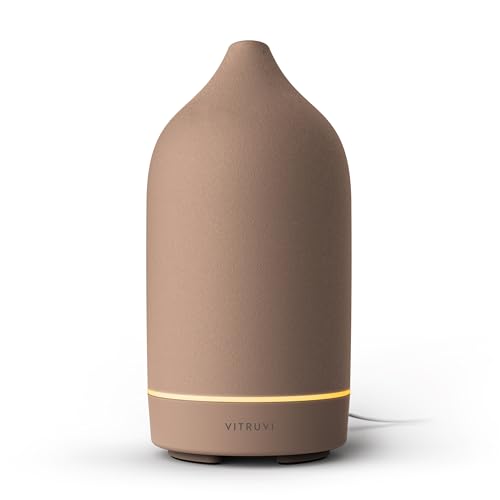
A diffuser is a scent instrument. The design goals are all fragrance goals: even dispersal of a small quantity of oil, a plume gentle enough not to wet a surface, quiet operation, an intermittent mode so the scent does not become overwhelming, and, increasingly, a form factor you are willing to leave on a shelf. The Vitruvi Stone at $129.99 is the design-led example and the ASAKUKI 500 mL at $19.99 is the volume staple. Pair either with an oil worth using, such as Plant Therapy Eucalyptus Globulus at $14.99.
A humidifier is a room instrument. Its design goals are output rate, tank capacity, run time per fill, noise at a bedside, ease of cleaning, and ideally a humidistat so it can stop when the room reaches 30 to 50 percent relative humidity rather than running blind. Nothing on that list has anything to do with scent, which is why manufacturers who care about durability tell you to keep oils out of the tank.
Waterless diffusers make the distinction absolute. The Vitruvi Air at $149.99, the Aera Mini at $95.00 and the Pura 4 at $49.99 disperse fragrance without a water reservoir at all. Their humidity contribution is exactly zero, which is a feature if you live somewhere already damp. Our rankings live at best essential oil diffusers and best waterless diffusers.
Where essential oils are actually allowed
Essential oils are not water-soluble. In a plain humidifier tank they float rather than mix, and three specific things follow. On an ultrasonic unit, oil coats the transducer disc that has to be in direct contact with clean water to atomize it, which reduces or stops mist output and is sometimes permanent. On an evaporative unit, oil soaks into the wick filter and degrades it, which is both a performance and a hygiene problem. On any unit, prolonged contact with oils can cloud, soften or craze plastics and degrade gaskets, which is why most manuals prohibit tank additives and why doing it anyway typically voids the warranty.
There are two legitimate places for oil. The first is a real diffuser, built from the ground up to atomize a water-and-oil mixture and cleaned accordingly. The second is a humidifier with a dedicated essential-oil tray, a compartment isolated from the water path where a few drops evaporate into the airstream rather than passing through the misting mechanism. The Levoit 3 L cool mist with an essential oil tray at $43.99 is the cleanest example of the type, and the Frida Baby 3-in-1 at $43.49 builds cool mist, a diffuser function and a night light into one nursery-shaped unit.
One caution for households with pets or young children: some essential oils are not appropriate to diffuse around them, and guidance varies by oil and by species. Check with your veterinarian or clinician for your specific situation rather than assuming that a product sold for home use is universally safe to run in a closed room.
Which do you actually need?
You want the room to smell good. Buy a diffuser. The ASAKUKI 500 mL at $19.99 is the value answer and the Vitruvi Stone at $129.99 is the one you buy when it has to look like an object rather than an appliance. If you live somewhere humid, take a waterless unit and add no moisture at all.
Your room is dry and your throat is raw in the morning. Buy a humidifier, and measure first. A Govee H5075 hygrometer at $11.69 tells you whether the room is genuinely below 30 percent relative humidity or whether it just feels that way. If it is, the Levoit LV600S at $109.00 with its humidistat is the set-and-forget answer, and the targets are in ideal humidity for a bedroom.
You want both. Two options, and the honest one first: buy both machines. A $19.99 diffuser next to whatever humidifier the room needs is cheaper than most single units that try to do everything, and each does its own job properly. Alternatively, buy a humidifier with a real oil tray, such as the Levoit 3 L at $43.99, accepting that the scent output of a tray is gentler than a dedicated diffuser's.
It is for a nursery. The humidity job is the real job, and the machine must be cool mist, because the American Academy of Pediatrics recommends cool-mist units in children's rooms to avoid scalds from hot water and steam. The Frida Baby 3-in-1 at $43.49 is built for exactly this, with the diffuser function as a secondary capability rather than the point. Be conservative about what you diffuse around an infant, and check with a clinician rather than a product page. Full ranking at best humidifier for a baby.
Cleaning: the diffuser is smaller, not easier
People assume a small tank means a small chore, and the opposite is often true. A diffuser reservoir is narrow, awkwardly shaped and coated in oil residue, which does not rinse away with water the way plain mineral film does. The routine is to empty it after each use, wipe the reservoir with a little rubbing alcohol on a soft cloth to lift the oil, then rinse and dry, and to descale periodically with white vinegar. Skip the alcohol step and old oil accumulates, goes rancid, and colors the next scent you run.
Humidifier cleaning is a bigger job less frequently: empty and dry the tank daily, descale with white vinegar weekly, sanitize on the schedule in your manual, and replace wick filters on time if the unit uses them. The reasons are different too, since a humidifier's risk is microbial growth in a warm reservoir of standing water while a diffuser's is oil residue in a small one. Both routines are in how to clean a vaporizer.
One shared rule: never mix cleaning products in a tank, and never use an abrasive on an ultrasonic transducer, whether it lives in a $19.99 diffuser or a $149.99 humidifier. That small disc is the machine in both cases.
Ready to buy? Start with our top picks
Whatever this guide steered you toward, here's where most readers land, ranked on verified output and value. Live price check on each.
As an Amazon Associate we earn from qualifying purchases, at no cost to you.
Key terms
- Diffuser
- An appliance whose purpose is dispersing essential-oil scent into a room. Typically 300 to 700 mL, designed to release a small volume slowly, and not sized to change a room's relative humidity in any meaningful way.
- Humidifier
- An appliance whose purpose is raising a room's relative humidity, sized accordingly at 2.5 to 11 L, and judged on output rate, run time, noise and ease of cleaning. Scent is not part of its design brief.
- Waterless diffuser
- A fragrance device that atomizes or evaporates oil with no water reservoir at all, such as the Vitruvi Air, Aera and Pura units. Its contribution to room humidity is zero, which makes it the right choice in an already damp climate.
- Essential-oil tray
- A compartment on some humidifiers, isolated from the water path, where a few drops of oil evaporate into the airstream. The only place an essential oil legitimately belongs on a humidifier; a plain tank is not a substitute.
- Transducer
- The piezoelectric disc that atomizes water in both ultrasonic diffusers and ultrasonic humidifiers. It must contact clean water to work, which is why oil residue in the wrong machine reduces output and abrasives ruin it permanently.
Questions, answered
What is the difference between a diffuser and a humidifier?
Purpose and scale. A diffuser exists to disperse essential-oil scent and typically holds 300 to 700 mL, releasing that small volume slowly over hours. A humidifier exists to raise a room's relative humidity and typically holds 2.5 to 11 L, because that is what it takes to change the air in a room. Many of both use the same ultrasonic mechanism, but a 500 mL diffuser holds one twelfth of what a 6 L humidifier holds and is not built to empty itself into the air. Buy a diffuser for scent and a humidifier for dryness; the two are not substitutes.
Can a diffuser be used as a humidifier?
Not effectively. The water output of a typical 300 to 700 mL diffuser is a small fraction of what a humidifier moves, and it is deliberately released slowly so the scent lasts. If your bedroom reads below 30 percent relative humidity on a hygrometer, a diffuser will not move it into the 30 to 50 percent band the EPA commonly cites. Waterless diffusers such as the Vitruvi Air at $149.99, the Aera Mini at $95.00 and the Pura 4 at $49.99 add no moisture at all. If dry air is the problem, buy the appliance built for it.
Can I put essential oils in my humidifier?
Only if the manufacturer provides a dedicated essential-oil tray. Oils are not water-soluble, so in a plain tank they float rather than mix: on an ultrasonic unit they coat the transducer disc and reduce or stop mist output, on an evaporative unit they soak into and degrade the wick filter, and on any unit prolonged contact can cloud or craze plastics and degrade seals. Most manuals prohibit tank additives and doing it anyway usually voids the warranty. Humidifiers built for oils include the Levoit 3 L with an oil tray at $43.99 and the Frida Baby 3-in-1 at $43.49.
Which is better for a cold, a diffuser or a humidifier?
A humidifier, and for congestion specifically a steam vaporizer with a medicine cup. Dry air makes a raw throat and a stuffed nose meaningfully worse, so moving a bedroom into the 30 to 50 percent range is a real comfort improvement overnight, and a diffuser cannot do that. A diffuser can make a room smell of eucalyptus, which many people find pleasant while ill, but treat it as scent rather than relief. Nothing in this category is a treatment: added humidity and aromatics are comfort measures and there is no good evidence they shorten a cold.
Do humidifiers with oil trays work as well as real diffusers?
They work, and the scent is gentler. A tray evaporates a few drops into the airstream rather than atomizing an oil and water mixture through a dedicated mechanism, so the fragrance is subtler and you have less control over its intensity than a diffuser's intermittent modes give you. That is a reasonable trade if you want one appliance in a small bedroom. If scent is important to you, buying both is cheap: an ASAKUKI 500 mL is $19.99 next to whatever humidifier the room genuinely needs (prices verified via the Amazon Creators API on September 5, 2026).
Is a diffuser safe around babies and pets?
The device itself is a small appliance and the question is really about what you put in it. Some essential oils are not appropriate to diffuse around infants or around certain pets, and the guidance varies by oil and by species, so check with a clinician or your veterinarian for your specific situation rather than assuming a product sold for home use is safe to run in a closed room with them. For a nursery, the humidity job is the real job and the machine should be cool mist per AAP guidance; the Frida Baby 3-in-1 at $43.49 combines cool mist with a diffuser function.
How do I clean a diffuser?
Empty it after use, then wipe the reservoir with a little rubbing alcohol on a soft cloth to lift the oil residue, since water alone will not remove it, then rinse and dry. Descale periodically with white vinegar the same way you would a humidifier. Skipping the alcohol step is what leaves old oil accumulating in the reservoir, which goes rancid and taints the next scent you run. Never use an abrasive on the transducer disc, which is as delicate in a $19.99 diffuser as it is in an expensive humidifier.
Should I just buy both?
Often, yes, and it is cheaper than people expect. A good value diffuser is $19.99 and a design piece is $129.99, either of which sits alongside whatever humidifier your room actually needs rather than compromising it. Each machine then does the job it was designed for: the humidifier holds 30 to 50 percent relative humidity with a humidistat, and the diffuser handles scent on its own schedule with a mechanism built to be cleaned of oil. The alternative, a single humidifier with an oil tray, is a fine compromise if space or budget makes two units impractical.
Filed under Explainer
Part of Vaporizer 101 · Head-to-Head Comparisons
Keep reading
Can You Put Vicks in a Humidifier?
The same rule in more detail: what belongs in a tank, in a cup, in a pad slot, and in an oil tray.
Ideal Humidity for a Bedroom
Measure before you buy either appliance. The 30 to 50 percent target and the $11 tool that settles it.
How to Choose a Vaporizer
Scent, moisture, congestion, skin or sinuses: seven problems, seven different machines, routed in two minutes.
How to Clean a Vaporizer
Alcohol for oil, vinegar for scale, and the daily habit that keeps either machine worth owning.