Our Pick: Boveda
Check price on Amazon →Boveda 58 vs 62 (2026): Which One for a Vaporizer?
Both cost $23.99 for a four-pack of size 67, so this is a preference decision rather than a price one. The short version: many dry-herb vaporizer owners report choosing the drier 58 percent packs on the reasoning that drier material grinds more evenly and vaporizes more evenly, while 62 percent is the more common choice for general storage and for keeping material from going brittle. Prices verified live via the Amazon Creators API on September 5, 2026.
By The Herbal Vaporizer Desk2026-09-05~8 min read Ranked on verified output, never box claimsHow we research
If you own a dry-herb vaporizer, start with the 58 percent packs. That is the direction a large share of vaporizer owners consistently report preferring, on the reasoning that slightly drier material grinds into a more even bed and gives off vapour more readily at a given temperature. It is a consensus, not a manufacturer specification, and we are going to be careful about the difference throughout this page.
The economics do not help you choose, because there are none. Boveda lists the 58 percent size 67 four-pack and the 62 percent size 67 four-pack at the same $23.99, verified via the Amazon Creators API on September 5, 2026. Singles are similarly close, at $9.98 for the 58 percent and $9.95 for the 62 percent. So the entire decision is about what four percentage points of relative humidity do to material you are about to heat, and about which failure mode you would rather risk.
This is a research and verification comparison. What Boveda publishes about how its packs work, two-way regulation that both releases and absorbs moisture to hold a stated relative humidity inside a sealed container, is the manufacturer's own description and we report it as such. What owners report about preferring one level over the other for vaporizing is community consensus, and we label it that way every time. We have not run humidity trials, we do not operate a physical test lab, and we will not present a preference as a finding. Prices move. No brand paid for a placement, and if you buy through our links we may earn an Amazon commission at no extra cost to you.
The short version
- Same price, so choose on preference: the 58 percent and 62 percent size 67 four-packs both list at $23.99 as of September 5, 2026.
- For vaporizing specifically, owner consensus leans 58 percent. Drier material grinds to a more even bed and tends to give off vapour more readily at a given temperature. That is consensus, not a maker claim.
- For general storage, 62 percent is the more common choice. It is the safer setting against material drying out and going brittle, especially in a dry climate or a heated home.
- Both packs are two-way. Boveda's published design both releases and absorbs moisture to hold the stated level, which is why either one only works inside a container that actually seals.
- Size is a separate decision from percentage. Size 67 suits small jars; size 320 at $28.99 is for larger containers, and a size 67 12 count is $62.99 if you run several jars.
At a glance
| Pack | Target RH | Size | Best for | Price (9/5/26) | Check price |
|---|---|---|---|---|---|
| Boveda 58% size 67, 4-pack | 58 percent | Size 67 | Dry-herb vaporizing (owner consensus) | $23.99 | Check price on Amazon |
| Boveda 62% size 67, 4-pack | 62 percent | Size 67 | General storage, dry homes | $23.99 | Check price on Amazon |
| Boveda 62% size 320 | 62 percent | Size 320 | Larger containers and bulk storage | $28.99 | Check price on Amazon |
The two packs, side by side, plus the larger size for bigger containers. Prices are live Amazon figures verified via the Creators API on September 5, 2026. Relative humidity figures are Boveda's published targets.
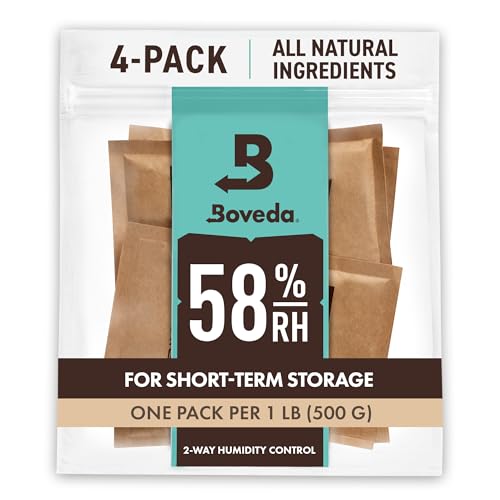
Boveda 58% Size 67, 4-Pack
Boveda
The drier pack, and the one most vaporizer owners report preferring.
Our verdict: If your material is going into a vaporizer, this is where we would start. The reasoning owners give consistently is that slightly drier material breaks up into a more even grind and gives off vapour more readily at a given temperature, and enough people report it independently that it is worth acting on. It is consensus rather than a published finding, and four percentage points is a small difference.
Verified: Boveda's published two-way design targets 58 percent relative humidity inside a sealed container. Size 67 four-pack live at $23.99 on Amazon, verified via the Creators API on September 5, 2026.
The vaporizer-leaning choice. Boveda 58 percent size 67 packs at $23.99 for four hold a sealed container at a lower target than the 62 percent version, and that is the whole functional difference between them.
Practical notes. Boveda packs only regulate inside something that seals, so pair these with a proper container such as the Herb Guard UV jar at $17.99 rather than a bag. And packs are consumables: they gradually stiffen as they exhaust, and a hard pack is a spent pack. A single 58 percent pack lists at $9.98 if you want to try one before committing to four.
Who should buy it
Buy 58 percent if the material is destined for a dry-herb vaporizer, if you already find your grind clumping, or if you live somewhere humid enough that the risk of over-drying is low. It is the default we would suggest to a vaporizer owner buying their first pack.
What we don't like
The case for it is owner consensus rather than published data, and four percentage points is a subtle difference that many people will not notice at all. In a very dry home it also gives you less margin before material becomes brittle.
- Target RH
- 58 percent (maker-stated)
- Type
- Two-way humidity control
- Size
- Size 67
- Count
- 4-pack
- Single pack price
- $9.98
- Live price (9/5/26)
- $23.99
What we like
- The level most vaporizer owners report preferring
- Drier material grinds to a more even, less clumping bed
- Same $23.99 as the 62 percent four-pack
Worth noting
- The vaporizer case is consensus, not published data
- Less margin against over-drying in a dry home
- Consumable, so it is a recurring cost

Boveda 62% Size 67, 4-Pack
Boveda
The default storage level, and the safer choice in a dry home.
Our verdict: The more widely bought of the two, and the right answer if storage rather than vaporizing is the job. Sixty-two percent gives more margin against material drying out and crumbling, which is the failure mode that actually ruins a batch. In a heated home in winter, or anywhere genuinely arid, we would take that margin over the vaporizing preference.
Verified: Boveda's published two-way design targets 62 percent relative humidity inside a sealed container. Size 67 four-pack live at $23.99 on Amazon, verified via the Creators API on September 5, 2026.
The safer setting. Boveda 62 percent size 67 packs at $23.99 for four are the general-purpose choice, and the one most people buy without thinking about it.
This is also the version Boveda publishes in the widest range of formats, which matters if your storage is not a single small jar: a size 67 12 count lists at $62.99 for people running several containers, and the larger size 320 is $28.99. Whichever level you choose, the pack needs a sealing container to regulate against, which is the point of a jar like the Herb Guard UV jar.
Who should buy it
Buy 62 percent if you live in a dry climate or a heated home, if you store material for weeks rather than days, or if you use it for more than one purpose and want a single sensible setting for everything.
What we don't like
It is the wetter of the two, which is the direction that causes clumping in a grinder and denser packing in a chamber. Owners who care most about vaporizer performance more often report reaching for the 58 percent instead.
- Target RH
- 62 percent (maker-stated)
- Type
- Two-way humidity control
- Size
- Size 67
- Count
- 4-pack
- Other formats
- 12 ct at $62.99, single at $9.95
- Live price (9/5/26)
- $23.99
What we like
- More margin against material drying out and crumbling
- The widest range of pack sizes and counts
- The sensible single setting if storage is mixed-purpose
Worth noting
- Damper material clumps more in a grinder
- Less favoured by vaporizer owners specifically
- Same recurring consumable cost

Boveda 62% Size 320
Boveda
The large-format pack at $28.99, when the container is bigger than a jar.
Our verdict: If the real problem is that your container is too big for a size 67 pack to regulate, the percentage debate is a distraction. Boveda's size 320 at $28.99 is built for larger volumes, and an undersized pack in an oversized container simply exhausts itself early while never reaching the target.
Verified: Boveda size 320 pack at 62 percent target relative humidity. Live at $28.99 on Amazon, verified via the Creators API on September 5, 2026.
Size before percentage. A humidity pack has a finite amount of work in it, and a size 320 pack at $28.99 exists because a size 67 cannot regulate a large container properly.
If you are storing at any real volume, a hygrometer earns its keep here. The Govee H5075 at $11.69 tells you whether the container is actually holding its target instead of leaving you to guess from the feel of the pack.
Who should buy it
Buy the size 320 if your storage container is larger than a small jar, or if your size 67 packs keep going hard within weeks. It is a capacity fix rather than a preference one.
What we don't like
It is only offered at 62 percent in our verified data, so it takes the percentage choice away from you, and at $28.99 for a single large pack the cost per container is higher than a four-pack of small ones.
- Target RH
- 62 percent (maker-stated)
- Type
- Two-way humidity control
- Size
- Size 320
- Best use
- Larger containers, bulk storage
- Live price (9/5/26)
- $28.99
What we like
- Sized for containers a size 67 cannot regulate
- Fixes packs that keep exhausting early
- One pack instead of several small ones
Worth noting
- Only 62 percent in our verified data
- $28.99 for a single pack
- Overkill for a quarter-ounce jar
What two-way humidity control actually does
A Boveda pack is a sealed, semi-permeable envelope containing a saturated salt solution. Boveda's published design is two-way: when the air inside a sealed container is drier than the pack's target, the pack gives up moisture into it; when the air is damper than the target, the pack takes moisture back. That bidirectionality is the whole reason these replaced the old approach of dropping something wet into a jar and hoping, which only ever pushed in one direction and frequently overshot.
Two consequences follow, and both are practical. First, the pack only works inside a container that seals. In a plastic bag or a loose-lidded tin, the pack is regulating against the whole room, which it cannot do, so it exhausts itself in weeks and the material still drifts. A gasketed jar such as the Herb Guard UV jar at $17.99 is what turns a pack from decoration into a system.
Second, packs are consumables with a finite capacity. As a pack works, the solution inside gradually crystallises and the pack stiffens. A pack that has gone hard is spent, and no amount of waiting brings it back. How long that takes depends entirely on how big the container is, how often it is opened, and how far the room's humidity sits from the pack's target. That is why a four-pack at $23.99 is the sensible format rather than a single.
Why humidity changes a vaporizer session at all
A dry-herb vaporizer is an airflow machine. In a convection device, the heater warms air and the draw pulls that air through a bed of packed material, so the physical state of the bed is part of the machine's behaviour. Moisture content changes that state in two ways that owners describe consistently.
It changes how material grinds and packs. Damper plant matter is springier and stickier. It tends to clump on grinder teeth rather than separating cleanly, and a load of slightly damp, clumped material settles denser in a chamber than an evenly ground dry one. Denser packing means higher airflow resistance, and a convection oven with restricted airflow delivers less of what it is capable of. Getting an even grind in the first place is the grinder's job, which is why the grinder guide and this page are two halves of the same problem.
It changes how heat behaves. Water in the material absorbs energy, so at any given temperature setting a damper load spends more of the early part of a session driving off moisture before vapour production really begins. Owners describe this as a slow first draw or as needing to run hotter than usual. Note carefully what this is: a mechanically plausible explanation of a widely reported experience. It is not something we have measured, and it is not a manufacturer claim.
The case for 58 percent, stated honestly
Among dry-herb vaporizer owners specifically, the drier pack is the more commonly recommended one, and the reasons given are consistent enough across independent sources to be worth acting on. Material stored at 58 percent is reported to break apart more cleanly in a grinder, to pack into a more evenly porous bed, and to start producing visible vapour sooner at a given temperature. Some owners also report that the flavour they associate with a well-run low-temperature session comes through more clearly, though flavour reports are the least reliable category of evidence there is.
What we will not do is dress this up as a finding. Boveda does not publish a vaporizer-specific recommendation in our verified data, and there is no measurement of ours behind any of it. What exists is a broad and consistent owner preference, which is a real signal and a weak one. Four percentage points of relative humidity is a small difference, and a meaningful number of people who have tried both report noticing nothing at all.
The practical way to settle it for yourself costs nothing extra: both four-packs are $23.99, so buy the 58 percent, run a season on it, and if material starts feeling brittle or crumbling in the grinder, switch to 62 percent next time. If you would rather test on a smaller commitment, singles are $9.98 for the 58 percent and $9.95 for the 62 percent.
The case for 62 percent, and when it is clearly right
Sixty-two percent is the higher-volume seller, and there are three situations where we would choose it without hesitation.
A dry home. Forced-air heating in winter routinely pulls indoor relative humidity well below the 30 to 50 percent band commonly cited as comfortable for people, and every time a jar is opened it exchanges air with that room. In that environment, the extra four points is margin against the irreversible failure mode rather than a stylistic preference.
Mixed-purpose storage. If the same jar serves more than one use, 62 percent is the safer single setting, because the cost of slightly damp material in a vaporizer is a marginally slower start, while the cost of over-dried material is a batch that crumbles to dust.
Long storage. The longer material sits, the more total moisture exchange happens through every opening and every imperfect seal, and the more the higher target earns its keep. If you buy in quantity and work through it over months, start at 62 percent and consider stepping a working jar down to 58 percent for the portion you are actively using. That two-jar approach, bulk at 62 and working stock at 58, is the arrangement a lot of experienced owners settle into, and it sidesteps the argument entirely.
How to set up storage properly, whichever pack you buy
The pack is one component of three, and it does very little on its own. The container has to seal, and ideally block light: UV glass is the standard for a reason, and the Herb Guard quarter-ounce UV jar at $17.99 ships with a humidity pack included. For anything that travels, glass is the wrong material and a sealed aluminum tube like the ONGROK at $14.99 is the better call.
The pack goes in loose, sized to the container, and gets replaced when it stiffens. Do not cut a pack open, do not add water to it, and do not put a pack directly against material if the maker's packaging advises otherwise. The monitor is optional and cheap: at $11.69 the Govee turns the whole arrangement from a hope into a reading, and it is the fastest way to discover that a lid you trusted does not seal.
One more habit worth adopting: open the jar as little as possible. Every opening dumps the conditioned air and makes the pack start over, which is the single biggest determinant of how long a $23.99 four-pack lasts. Batch grinding into a working jar, rather than opening the bulk container daily, is the routine that follows from that, and it is another reason a proper accessory kit pays for itself.
More picks worth comparing
Beyond this guide, the highest-rated picks across every category and budget, with a live price check on each.


As an Amazon Associate we earn from qualifying purchases, at no cost to you.
Quick shop: every pick
Skip the scroll: the whole lineup, with a live price check on each.
- Boveda 58% Size 67, 4-PackBest for Dry-Herb VaporizingBoveda · $23.99Check price on Amazon
- Boveda 62% Size 67, 4-PackBest for General StorageBoveda · $23.99Check price on Amazon
- Boveda 62% Size 320If Neither: Bigger ContainersBoveda · $28.99Check price on Amazon
How we chose
We separate three kinds of statement on this page and label each one. Boveda's published description of how its packs work, two-way regulation holding a stated relative humidity inside a sealed container, is the manufacturer's claim. Prices are live Amazon Creators API pulls from September 5, 2026. And the preference for 58 percent among dry-herb vaporizer owners is community consensus drawn from the consistent, repeated reports we track, which is a weaker class of evidence than either of the first two and is presented that way throughout.
We did not run comparative humidity trials, measure moisture content, or evaluate vapour output at different storage levels. We do not operate a physical test lab. Where Boveda publishes a figure we print it; where the only available answer is what owners say, we say that is what it is. Neither Boveda nor any retailer paid for a placement or saw this page before it went live.
Key terms
- Two-way humidity control
- A pack that both releases moisture into dry air and absorbs it from damp air, holding a sealed container at a stated relative humidity. It is Boveda's published design and the reason these replaced one-directional humidification methods.
- Relative humidity (RH)
- The amount of water vapour in air as a percentage of the maximum that air can hold at its current temperature. Boveda packs are labeled by the RH they target inside a sealed container: 58 percent or 62 percent here.
- Size 67 and size 320
- Boveda's pack capacities. Size 67 suits a small jar and lists at $23.99 for four; size 320 is the large-container pack at $28.99. An undersized pack exhausts early and never reaches its target, which is a capacity problem rather than a percentage one.
- Spent pack
- A humidity pack that has crystallised and gone hard, meaning its moisture capacity is used up. It cannot be revived, and a hard pack in a jar is doing nothing at all.
- Owner consensus
- Where the 58 percent recommendation on this page comes from: the consistent, repeated preference of dry-herb vaporizer owners across the sources we track, rather than a manufacturer specification or a measurement of ours.
Questions, answered
Should I use Boveda 58 or 62 for a dry-herb vaporizer?
Owner consensus leans toward 58 percent for vaporizing, on the reasoning that slightly drier material breaks up into a more even grind, packs into a more porous bed, and starts producing vapour sooner at a given temperature. That is a widely reported preference rather than a Boveda recommendation or a measurement of ours, and four percentage points is a subtle difference many people do not notice. Both list at $23.99 for a size 67 four-pack as of September 5, 2026, so there is no cost penalty to starting with 58 percent and switching if material starts feeling brittle.
What is the actual difference between Boveda 58% and 62%?
Four percentage points of target relative humidity inside a sealed container, and nothing else. Both are two-way packs that release moisture into dry air and absorb it from damp air, both come in size 67 four-packs at $23.99, and both need a container that seals in order to work at all. The 58 percent pack holds material slightly drier, which owners associate with better grinding and vaporizing; the 62 percent pack holds it slightly damper, which gives more margin against over-drying.
Is 62% Boveda too wet for a vaporizer?
No, and plenty of people use it happily. The reported downsides are marginal rather than disqualifying: damper material tends to clump slightly more on grinder teeth and pack a little denser in a chamber, and a damper load can be slower to start producing visible vapour because water absorbs heat. If you live somewhere dry or heat your home in winter, 62 percent is a reasonable trade for the extra protection against material drying out and crumbling, which is the failure you cannot undo.
How long do Boveda packs last?
Boveda does not publish a single lifespan figure in our verified data and we will not invent one, because the honest answer depends on variables you control. Container size, how often you open it, how well the lid seals, and how far your room humidity sits from the pack's target all determine how quickly a pack exhausts. The reliable indicator is physical: a pack stiffens as it works and a hard pack is spent. Buying the $23.99 four-pack rather than a single is the sensible response to that uncertainty.
Do Boveda packs work in a plastic bag?
Barely, and not for long. Two-way regulation depends on a sealed volume for the pack to condition, and a bag exchanges air with the room continuously. The result is a pack that exhausts within weeks while the material inside still drifts toward the room's humidity. Use a container that actually seals, such as the Herb Guard UV jar at $17.99 which ships with a pack included, or a sealed aluminum tube like the ONGROK at $14.99 if the storage needs to travel.
What size Boveda do I need?
Size 67 for a small jar, which is the format both the 58 percent and 62 percent four-packs come in at $23.99. Size 320 at $28.99 for a larger container. The symptom of an undersized pack is that it goes hard within weeks while the container still reads dry, which means it is being asked to condition more air and material than it holds moisture for. That is a capacity problem, and swapping percentage will not fix it. Boveda also publishes a size 67 12 count at $62.99 if you keep several jars going.
Can I use a Boveda pack more than once?
You can keep using a pack until it stiffens, but you cannot recharge one once it has. As a pack works, the salt solution inside gradually crystallises, and a hard pack has used up its capacity. Do not cut a pack open, add water, or try to rehydrate it, since the pack's regulation depends on a specific saturated solution and a sealed envelope. Replace it instead, which is why these are sold in four-packs and twelve-counts rather than singly.
Do I need a hygrometer as well?
Not strictly, but at $11.69 for the Govee H5075 it answers two questions a pack cannot. First, whether your container actually seals, which a great many people discover it does not. Second, whether the pack is still working, since a pack can be quietly spent for weeks before you notice by feel. If you store more than a small amount or you have gone to the trouble of choosing between 58 and 62 percent, it is worth knowing which number you are actually holding.
Filed under Comparison
Part of Dry-Herb Accessories & Care
Keep reading
Best Vaporizer Accessories (2026)
The full kit around the device: grind, store, clean, carry and filter, with live prices.
Best Herb Grinders (2026)
The other half of the material problem: why grind consistency decides an even session.
How to Use a Dry-Herb Vaporizer
Where storage humidity fits into grind, pack, temperature and draw.
Dry-Herb Vaporizer Temperature Guide
Why moisture content changes what a given temperature setting actually delivers.